April 22, 2026 · Bam Good Time
The State of American Mahjong 2026: A Data Report
We counted more than 700 mahjong clubs across the United States. Here's what the data shows about where the game is thriving, when Americans play, and what's driving the 2026 boom.
Published April 22, 2026 · Research by Bam Good Time
Updated October 19, 2026. We rebuilt this report from a smaller set of sources. One directory we had drawn on asked us to stop using its listings, so we removed every club that came from it and recalculated every figure below. The snapshot date is still April 22, 2026. We also used corrected city names for listings whose city was recorded wrong in April.
American mahjong is in the middle of a boom. Anyone who's tried to sign up for a beginner lesson in the past year has noticed the waitlists. Anyone who's walked into a game store looking for a set has seen the shelves emptying. The anecdotes are everywhere. But what does the data actually say?
We set out to answer that question. In 2026, Bam Good Time built a cross-source aggregator that pulls public mahjong club listings from Modern Mahjong, Sloperama's legacy index, Meetup, and our own first-party directory. After deduplication, we're left with 730 unique clubs in 49 states. This report is what that dataset has to say about the shape of American mahjong right now.
Executive summary
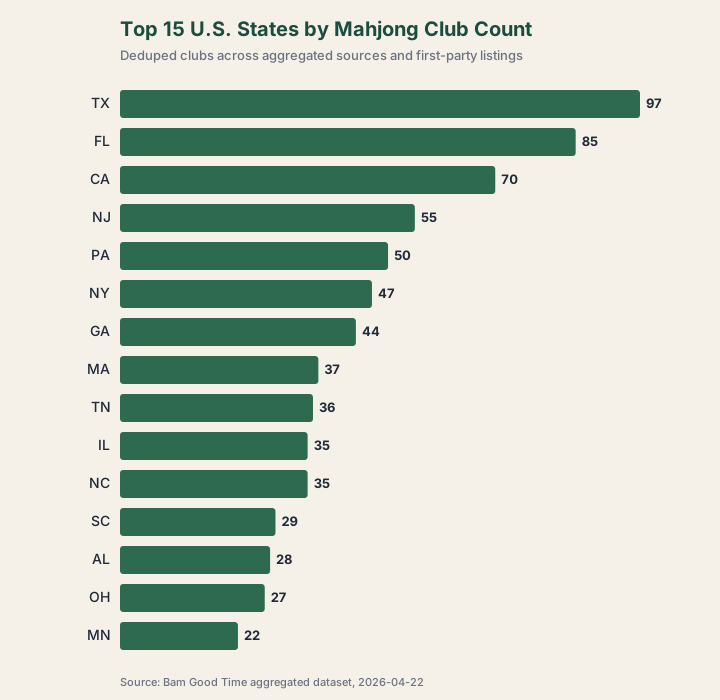
- Florida leads the raw count (63 clubs), followed by California (55), Texas (52), New Jersey (48), and Pennsylvania (45). Together the top five states account for 36% of all known clubs.
- Per capita, the Northeast leads. New Jersey (5.17 clubs per million residents) is the densest of the states with at least 15 clubs, followed by Massachusetts (3.57), Pennsylvania (3.47), Tennessee (3.37), and Wisconsin (3.21). Among smaller states, Vermont and Maine stand out even more.
- Wednesday is mahjong day. Where a day of the week is mentioned, Wednesday appears in 59 club descriptions, more than any other day. Afternoon is the dominant time slot; evening and weekend play are rare.
- American mahjong (NMJL) dominates. Of clubs that explicitly name a variant, about 90% mention American. Riichi and Hong Kong variants exist in the dataset, but only in small numbers.
- The long tail is the whole story. No city has more than six listed clubs, and only four cities have four or more. Those four account for 18 clubs, under 3% of the total. Everything else is spread across hundreds of cities and towns.
Methodology
This is a snapshot, not a census. We combined three sources:
- Modern Mahjong: the state-by-state "Where To Play" pages on modernmahjong.com (574 clubs).
- Sloperama + Meetup: smaller feeds we pull for completeness (5 combined).
- Bam Good Time first-party listings: clubs that have claimed or created their presence on our platform (173 clubs, all public-listing).
We filter to listings that were active on April 22, 2026, dedupe on a lowercased (name, city, state) key, and normalize state codes to two-letter uppercase. Clubs with missing or unreadable state data (11 total) are excluded from state-level analysis.
For per-capita statistics, we use Census Bureau 2023 state population estimates and 2022 city population estimates. We cap the per-capita city ranking at cities with at least 100,000 residents and at least four known clubs, because tiny-denominator results turn into noise quickly.
For meeting-day and variant analysis, we parse the free-text description field on aggregated listings. Substring matches are coarse, a club description mentioning "Wednesday" counts as a Wednesday club, even if the group actually plays multiple days or the text is discussing a special event. We report these numbers as signals, not precise counts.
Raw data tables and the generator script are kept in our private code repository. The state-level counts are reproduced in the reference table at the end of this report.
The geography of American mahjong
The raw ranking is dominated by the biggest states, which is exactly what you'd expect. Florida has the most clubs in our dataset, spread heavily along the Gulf and Atlantic coasts. California is second, with clubs clustered in Los Angeles, San Diego and the Bay Area. Texas is third, with clusters in Houston, Dallas, Austin and San Antonio. Browse clubs by state to see the full map.
But club count by itself tells you where mahjong exists in absolute terms, not where it's cultural. For that, per-capita density is more useful.
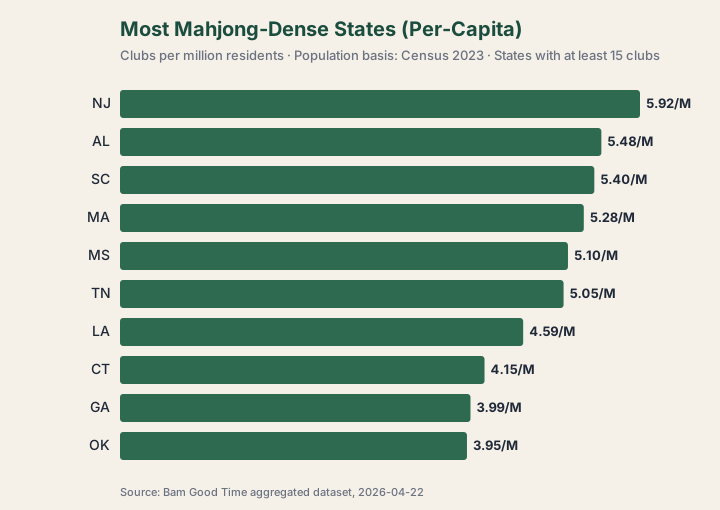
New Jersey leads every state with at least 15 clubs on clubs per million residents, at 5.17. That's not a surprise, New Jersey has a long tradition of Jewish community-center mahjong dating back to the 1940s, combined with a dense suburban fabric and a cluster of retirement communities at the shore.
Massachusetts (3.57) and Pennsylvania (3.47) follow, which fits the same pattern: older suburbs, strong community-center and synagogue programs, and libraries that host weekly games. Tennessee (3.37) is the one Southern state in the top five, and Wisconsin (3.21) is a reminder that the game has deep roots in the upper Midwest too.
Several factors are probably at play. Dense networks of community clubs, garden clubs, and country-club social programs tend to absorb mahjong quickly once it reaches them. Regions with many active retirees, including retirees who moved south from the Northeast and brought weekly games with them, also over-produce clubs. And in several states we've noticed that mahjong tends to travel friend-to-friend through book clubs and church groups faster than it travels through commercial channels.
California's low per-capita rank (1.41 per million, below the national average of 2.18) is also worth noting. The state's absolute count is high because its population is enormous, but dense geographic concentration makes the picture misleading, there are mahjong-rich pockets around Los Angeles and San Francisco and huge gaps in between. Texas (1.70) shows the same effect.
Two New England states deserve a separate call-out. Vermont has 10 known clubs against a population of roughly 650,000, about 15.5 clubs per million residents, the highest per-capita figure in our dataset by a wide margin. Maine has 12 clubs at 8.6 per million, also well above every state with a larger absolute count. Both are small enough that we excluded them from the per-capita chart above (which applies a minimum of 15 clubs to avoid small-denominator noise), but the underlying numbers are real and the pattern fits: regions with tight community networks, active senior populations, and active town libraries tend to over-produce mahjong clubs relative to their size.
City spotlights
At the city level, the leaderboard compresses almost to nothing. No U.S. city has more than six publicly listed clubs in our data. The distribution is long-tailed rather than winner-take-all.
The absolute-count leader is Houston, TX with 6 clubs, followed by Los Angeles, CA, Denver, CO and Dallas, TX with 4 each. Five more cities have 3 each: Fort Lauderdale, Philadelphia, Mobile, Chattanooga and Johnson City, Tennessee.
Per capita, only those four cities clear our bar of at least four clubs and 100,000 residents:
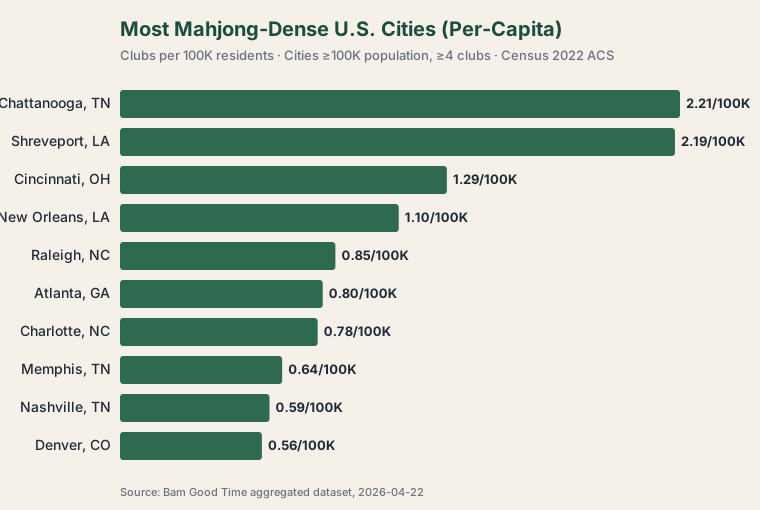
Denver (0.56 clubs per 100,000 residents) leads, then Dallas (0.31), Houston (0.26) and Los Angeles (0.10). With so few clubs per city, we would not read much into the order.
That is the real finding at the city level. The story of American mahjong in 2026 isn't really a story about big cities. It's a story about whoever happens to live in a given town, decides that a weekly game is worth organizing, and starts sending the invitations.
When Americans play: the Wednesday consensus
The most consistent pattern in the entire dataset has nothing to do with geography. It's a day of the week.
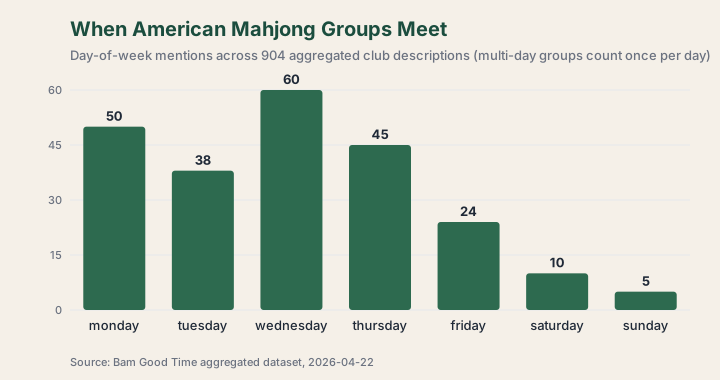
When we parse the free-text description field on aggregated listings for day-of-week mentions, Wednesday wins, and it's not close. Of the clubs that mention a specific day, Wednesday appears in 59 descriptions, a 20% lead over Monday (49), Thursday (45), and Tuesday (37). Friday drops to 24. Saturday is 10. Sunday is 5.
A few things are happening here. Wednesday is the classic "mahjong day" in mid-century Jewish community-center programming, a tradition that propagated outward through JCCs and country clubs from the 1950s onward. It's the right day of the week for a weekly event: far enough from the Monday reset that everyone has their footing, not so close to the weekend that family obligations pull people away. And once a community adopts Wednesday, it becomes self-reinforcing. You show up Wednesday because everyone else does, and the calendar slot accumulates gravity.
On time of day, the pattern is similar to what you'd expect. Of listings that mention a time, afternoon is the dominant slot (51 mentions, versus 19 for morning and only 6 for evening). American mahjong has historically been a daytime game, tied to community centers, senior centers, country clubs, and home-based afternoon gatherings rather than late-night social scenes.
This matters for anyone trying to start a club or schedule events. The data isn't telling you that Wednesday afternoon is the only option. It's telling you that the norm is strong enough that deviating from it requires a reason. If you're running a club for working-age players who can't get to an afternoon game, you're swimming against a current, and you should plan accordingly, tighter recruitment, more intentional retention, and probably a smaller but more committed group.
Variant trends
American mahjong is not the only mahjong played in the United States, but in our data it is overwhelmingly the dominant one.
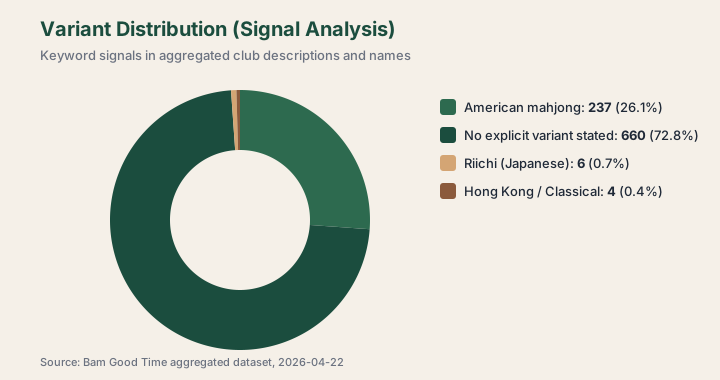
Of the 579 aggregated club listings, 60 descriptions mention "American mahjong," "NMJL," or the "National Mah Jongg League." Hong Kong / Cantonese variants appear in 3 descriptions. Riichi / Japanese variants appear in 5. One club mentions more than one variant.
The remaining 512 listings don't name a variant at all. This is most likely because the source directories, Modern Mahjong especially, default to indexing American mahjong groups, and the group organizers don't feel the need to specify what everyone already knows.
That said, the niche variants are present, just thinly: five Riichi listings and three Hong Kong ones are too few to say where either is growing.
For most readers of this report, though, the practical takeaway is simple. If someone in the United States says "mahjong" without further qualification in 2026, they almost certainly mean the American game, played with 152 tiles (including 8 Jokers), a Charleston, and a current-year NMJL card. If you're looking to learn for the first time, American is the path of least resistance, the most players, the most clubs, the most instructional material.
What's driving the 2026 boom
The numbers in this report describe the current state of American mahjong, but they don't really explain why the state is the way it is. For that, a few observations from the community side:
The pandemic created a cohort. During 2020 and 2021, many people learned mahjong over Zoom, in driveways, and in small pod games. When in-person returned, they came looking for clubs, and some went on to host their own.
The aesthetics changed. A new generation of tile set designers has overhauled the visual identity of the game. Modern sets have brighter colors, better typography, more personality. Instagram is now full of mahjong content that looks nothing like the utilitarian sets of the 1970s. Plenty of newer players bought a pretty set first and learned the game after, not the reverse.
Social media made the game legible. Mahjong is hard to describe in a TikTok caption, but it is extremely easy to film. The rhythm of the shuffle, the reveal of a hand, the clack of tiles on felt, the game has an aesthetic that the short-video era rewards. Mahjong-focused creators have built followings of their own, pulling curious first-time viewers toward local clubs.
Clubs got easier to run. The logistics of running a weekly game, RSVPs, rotating partners, handling waitlists, collecting dues, used to fall on a single volunteer's shoulders. Tools like ours now handle registration, payments, and rotation automatically. More organizers stay organizers because they're not drowning in spreadsheets. And for players who want their results to count beyond a single night, a free cross-club ELO rating now lives at Mahjic.org.
Seniors are driving the long trend. The 65-and-over U.S. population grew by more than 3 million between 2020 and 2023, according to Census Bureau estimates. Many moved. Some of that cohort already played mahjong or wanted to learn, and active-adult communities competed for them by offering more programming. In our data, retirement-heavy Florida and South Carolina both sit above the national average of clubs per resident.
None of these factors on its own would be enough. Together they compound. Bam Good Time is a late-arriving platform, we launched public club listings in early 2026, and 173 clubs had joined by the time we published (more than 900 by October 2026). The underlying growth rate of the community is higher than any single directory captures.
Limitations and what's missing
This dataset has real gaps. We want to be honest about them so readers can calibrate.
Private clubs and home games are undercounted. Country-club programs that don't maintain a public web presence, synagogue and JCC weekly games that live on paper flyers, and the many home mahjong groups that meet privately, none of this is in the data. The real number of Americans who play mahjong in any given week is several times our club count.
Variant counts are free-text signals, not rosters. Our 60-to-3-to-5 American / Hong Kong / Riichi split is based on keywords in descriptions. A Riichi club that just calls itself "Portland Mahjong" without elaborating won't register as Riichi. Take the distribution as a strong directional signal, not a precise breakdown.
Year-over-year growth is not directly measurable in this dataset. Because the aggregator was built in 2026, most records share a 2026 created_at timestamp regardless of when the underlying club actually started. Growth claims in this report are based on first-party registration trends, not on the aggregator timestamps.
Small-state counts are noisy. West Virginia, Kansas and Hawaii have one club each in this snapshot, and Oregon and Washington, D.C. have none. Those numbers might be accurate or might just reflect thin directory coverage. We'd rather you know that than not.
If you run a club that isn't in our public directory, add it here. The point of this report is to improve the baseline, not fix it in place.
Closing
The newest club in our dataset was added the week we published, and it joined a game that's been quietly holding American social life together for almost a century, four players at a square table, the click of tiles, a card printed fresh every spring.
Right now, new clubs are joining the map every week. And every week, somewhere in the country, someone picks up their first tile and doesn't put it down.
If this report was useful, pass it along. If you have data we don't, a club we missed, a city we under-counted, a story we got wrong, we want it. Email us at hello@bamgoodtime.com with corrections or extensions.
For the full per-state breakdown and links to every state-level club page, see the reference table below.
State-by-state reference
Every state page links to the active clubs, local history, and directory of known games in that state.
| State | Clubs | Per million |
|---|---|---|
| Florida | 63 | 2.79 |
| California | 55 | 1.41 |
| Texas | 52 | 1.70 |
| New Jersey | 48 | 5.17 |
| Pennsylvania | 45 | 3.47 |
| New York | 39 | 1.99 |
| Georgia | 28 | 2.54 |
| Illinois | 26 | 2.07 |
| Massachusetts | 25 | 3.57 |
| Tennessee | 24 | 3.37 |
| Ohio | 21 | 1.78 |
| North Carolina | 20 | 1.85 |
| Wisconsin | 19 | 3.21 |
| Minnesota | 17 | 2.96 |
| Virginia | 16 | 1.84 |
| South Carolina | 15 | 2.79 |
| Alabama | 14 | 2.74 |
| Connecticut | 13 | 3.59 |
| Arizona | 12 | 1.61 |
| Maine | 12 | 8.60 |
| Michigan | 12 | 1.20 |
| Colorado | 11 | 1.87 |
| Maryland | 10 | 1.62 |
| Oklahoma | 10 | 2.47 |
| Vermont | 10 | 15.46 |
| Indiana | 9 | 1.31 |
| Louisiana | 9 | 1.97 |
| Washington | 9 | 1.15 |
| New Hampshire | 8 | 5.71 |
| Arkansas | 7 | 2.28 |
| Mississippi | 7 | 2.38 |
| Delaware | 6 | 5.82 |
| Missouri | 6 | 0.97 |
| Iowa | 5 | 1.56 |
| Nevada | 5 | 1.57 |
| Kentucky | 4 | 0.88 |
| Rhode Island | 4 | 3.65 |
| Nebraska | 3 | 1.52 |
| Utah | 3 | 0.88 |
| Alaska | 2 | 2.73 |
| Idaho | 2 | 1.02 |
| Montana | 2 | 1.77 |
| New Mexico | 2 | 0.95 |
| North Dakota | 2 | 2.55 |
| South Dakota | 2 | 2.17 |
| Wyoming | 2 | 3.42 |
| Hawaii | 1 | 0.70 |
| Kansas | 1 | 0.34 |
| West Virginia | 1 | 0.56 |
Oregon and Washington, D.C. had no publicly listed club in this snapshot. If you run or know of a club anywhere that isn't listed, submit it here so neighboring players can find you.
This report is part of Bam Good Time's ongoing research on the American mahjong community. For related reads, see The History of American Mahjong, How to Start a Mahjong Club, and Find Mahjong Players Near Me.